Skip to main content
In 1894, an invitation from his uncle brought Rungius to America for a moose hunt in Maine. The hunt itself came up empty, but he decided to stay on for another year, and in 1895 Rungius traveled to Wyoming's Wind River Range, drawn by its native elk, moose, bear, deer, and pronghorn. He returned to the Wind Rivers regularly until 1920, and in 1901 he began traveling to New Brunswick in search of moose and deer.
In 1904, naturalist and adventurer Charles Sheldon invited Rungius to join an expedition to the Yukon to study mountain sheep. The trip proved pivotal: it sharpened his reputation as a premier wildlife artist and, through Sheldon and other connections, drew him into the heart of America's growing conservation movement alongside figures like President Theodore Roosevelt.
Rungius married his cousin Louise Fulda in 1907, and by 1910 the couple had settled in Manhattan, which remained their home base for the rest of their lives. He established an enduring rhythm early in his career—spending summers and falls hunting and sketching in the Rocky Mountains, then returning to New York to paint through the winter. He first visited Banff, Alberta, in 1910, and the region's abundance of mountain goats, sheep, moose, elk, bear, and caribou captivated him enough that in 1922 he built a home and studio there, which he named "The Paintbox." He returned to Banff nearly every year until 1957.
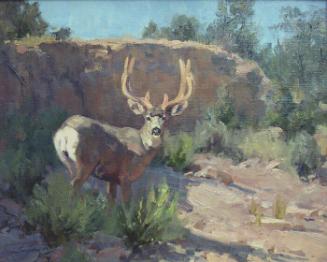
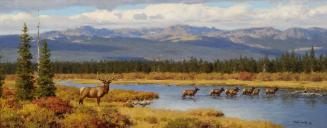
What set Rungius apart from his talented contemporaries was his ability to capture the charged, fleeting encounter with an animal in the wild. Equally skilled as a painter of wildlife and landscape, he built an enthusiastic following among fellow artists and patrons alike. He died of a stroke on October 20, 1959, at the age of ninety, seated at his easel.
Today, the National Museum of Wildlife Art holds the largest public collection of Rungius's work in the United States.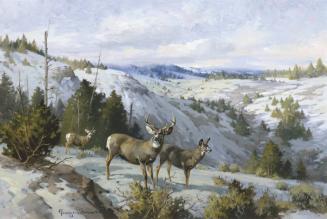
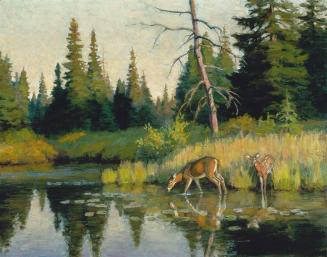
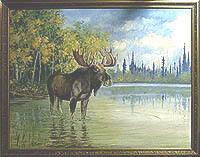
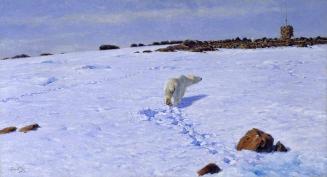




Carl Rungius
United States, born Germany, 1869 - 1959
Place of BirthGermany
Place of DeathUnited States of America
Biography Carl Rungius was born on August 18, 1869, near Berlin, Germany, and studied at the Royal Academy of Arts there from 1888 to 1890. Throughout his studies, Rungius sharpened his eye by sketching animals at the Berlin Zoo. That early discipline, which married anatomical precision with a keen sense of an animal's mannerisms and habitat, became a hallmark of his career.In 1894, an invitation from his uncle brought Rungius to America for a moose hunt in Maine. The hunt itself came up empty, but he decided to stay on for another year, and in 1895 Rungius traveled to Wyoming's Wind River Range, drawn by its native elk, moose, bear, deer, and pronghorn. He returned to the Wind Rivers regularly until 1920, and in 1901 he began traveling to New Brunswick in search of moose and deer.
In 1904, naturalist and adventurer Charles Sheldon invited Rungius to join an expedition to the Yukon to study mountain sheep. The trip proved pivotal: it sharpened his reputation as a premier wildlife artist and, through Sheldon and other connections, drew him into the heart of America's growing conservation movement alongside figures like President Theodore Roosevelt.
Rungius married his cousin Louise Fulda in 1907, and by 1910 the couple had settled in Manhattan, which remained their home base for the rest of their lives. He established an enduring rhythm early in his career—spending summers and falls hunting and sketching in the Rocky Mountains, then returning to New York to paint through the winter. He first visited Banff, Alberta, in 1910, and the region's abundance of mountain goats, sheep, moose, elk, bear, and caribou captivated him enough that in 1922 he built a home and studio there, which he named "The Paintbox." He returned to Banff nearly every year until 1957.
What set Rungius apart from his talented contemporaries was his ability to capture the charged, fleeting encounter with an animal in the wild. Equally skilled as a painter of wildlife and landscape, he built an enthusiastic following among fellow artists and patrons alike. He died of a stroke on October 20, 1959, at the age of ninety, seated at his easel.
Today, the National Museum of Wildlife Art holds the largest public collection of Rungius's work in the United States.
Person TypeIndividual
Terms
United States, 1896 - 1982